This is Juneteenth.
I had long known that on June 19th, 1865 -- Juneteenth -- the Emancipation Proclamation was announced in Texas.
That's the short version, of course, the "I learned it in elementary school" version. (Actually, I think it was in junior high.)
What I did not realize was that the man doing the announcing was General Gordon Granger. General Granger had been my great great grandfather's corps commander at the Battle of Chickamauga.
I'm not claiming any deep personal connection. It's unlikely General Granger had a clue who some random rifleman in Company K of the 22nd Michigan was, and G'G'Grandfather was still convalescing in a hospital in Detroit a year and a half after the battle, so he probably never saw Texas.
I think what impresses me more than the (tenuous) connection is the fact that, this morning, I actually learned something from a Pubic Service Announcement on TV.

Showing posts with label Civil War. Show all posts
Showing posts with label Civil War. Show all posts
Friday, June 19, 2020


Monday, November 19, 2018
On This Date...
...in 1863 President Abraham Lincoln stood up in Gettysburg, PA, and delivered what may be the greatest oration in American history:
Four score and seven years ago our fathers brought forth on this continent, a new nation, conceived in Liberty, and dedicated to the proposition that all men are created equal.Ironic to consider that it wasn't even supposed to be "the main event", which was supposed to be The Honorable Edward Everett's two hour long "Gettysburg Oration". The lesson there for public speakers is obvious.
Now we are engaged in a great civil war, testing whether that nation, or any nation so conceived and so dedicated, can long endure. We are met on a great battle-field of that war. We have come to dedicate a portion of that field, as a final resting place for those who here gave their lives that that nation might live. It is altogether fitting and proper that we should do this.
But, in a larger sense, we can not dedicate—we can not consecrate—we can not hallow—this ground. The brave men, living and dead, who struggled here, have consecrated it, far above our poor power to add or detract. The world will little note, nor long remember what we say here, but it can never forget what they did here. It is for us the living, rather, to be dedicated here to the unfinished work which they who fought here have thus far so nobly advanced. It is rather for us to be here dedicated to the great task remaining before us—that from these honored dead we take increased devotion to that cause for which they gave the last full measure of devotion—that we here highly resolve that these dead shall not have died in vain—that this nation, under God, shall have a new birth of freedom—and that government of the people, by the people, for the people, shall not perish from the earth.
Monday, May 28, 2018
Memorial Day, 2018
Or, Remembrance Day, or Decoration Day, depending on where and when you're from.
I don't now if this story is true -- I certainly never heard it before -- but I usually post a recording of "My Buddy"...
I don't now if this story is true -- I certainly never heard it before -- but I usually post a recording of "My Buddy"...
Sunday, May 25, 2014
Memorial Day, 2014

I've posted this song every Memorial Day since I began the blog, I think. Still seems to sum it up best.
And it occured to me that this one fits, too, if one is in a maudlin, or even a morbid, mood...
And this, of course...
I've seen more people posting this year than ever before a message I've tried to tell folks, reminding them that Memorial Day is the day we remember those who didn't make it home. This is, I suppose, an inherently morbid fact. The American Day of the Dead, if you will.
And, yes, we owe them, well, just about all the "blessings of liberty" we enjoy, even if we doubt whether the blessings are quite as abundant these days, or will last.
We also owe it to them that those blessings do not disappear. And if that means getting maudlin when we reflect on those who have sacrificed all they had, and more, even if it was in a conflict the wisdom or righteousness we question, then so be it.

Sunday, May 18, 2014
Quickie Book Review, The Global Crisis
Global Crisis: War, Climate Change and Catastrophe in the Seventeenth Century by Parker, Geoffrey (2013)
The subtitle says it all: This is not just a book about the Thirty Years War or the English Civil Wars, the Seventeenth Century was a time of upheaval all over and all around the world, not just through civil and religious wars, not just due to conquest and colonization, but also due to natural disaster (plagues, volcanoes, earthquakes) and through global climate change -- global cooling, to be precise. (This books was the source of my post Ancient Wisdom, Revolting Peasants Edition)
Amazon's Blurb:
This is a pretty thick tome, 697 pages of text, 871 including appendices, bibliography, and index. I had to extend the loan on it from the library to be able to finish it. It was well worth the time spent.
One thing that was striking to me was that the standard response to crop failures due to wars, rumors of wars, and the Maunder Minimum and it's ensuing Little Ice Age was to raise taxes on everything. The governments that handled the disruption the best were those that lowered taxes, and offered tax relief and food and other support to communities that had all they could do to survive.
Oddly, to a Westerner's eyes, this means Moghul India and Tokugawa Japan.
A cynic might point out that this actually meant more government control over the ordinary person's life; another sort of cynic would point out that this is a mater of degree, especially when discussing the Tokugawa Shogunate.
Parker does not just rely on documentary evidence -- memoirs, diaries, government records -- but also consults the "natural record", such as ice cores, tree ring counts, and so forth, to include climate evidence in areas where there is no reliable record of events or conditions.
One point that is often brought up is how a reduction of temperature of just one degree Celsius can shorten the growing season by weeks. Even if weather conditions are perfect for the shortened growing season (and when are they ever?), this shortened season can lead to shortages, if not outright famine.
One of the most valuable aspects of the book, in fact, is that it can also be viewed as a survey of actual global history of the period, covering as it does every continent (albeit there is no documentary record for Australia or Oceania, so the natural records must suffice) and most, if not all, nations. I will say, however, that many of the charts he includes that show things like income, population, or climate, are not necessarily related well to the text.
All in all, this is a valuable book, bringing together both historical and natural records from a variety of sources, and also covering areas that are often ignored as being "outside the scope" of other studies. As I said, I felt it was well worth the time to read it.
The subtitle says it all: This is not just a book about the Thirty Years War or the English Civil Wars, the Seventeenth Century was a time of upheaval all over and all around the world, not just through civil and religious wars, not just due to conquest and colonization, but also due to natural disaster (plagues, volcanoes, earthquakes) and through global climate change -- global cooling, to be precise. (This books was the source of my post Ancient Wisdom, Revolting Peasants Edition)
Amazon's Blurb:
Revolutions, droughts, famines, invasions, wars, regicides, government collapses—the calamities of the mid-seventeenth century were unprecedented in both frequency and extent. The effects of what historians call the "General Crisis" extended from England to Japan, from the Russian Empire to sub-Saharan Africa. The Americas, too, did not escape the turbulence of the time.
In this meticulously researched volume, master historian Geoffrey Parker presents the firsthand testimony of men and women who saw and suffered from the sequence of political, economic, and social crises between 1618 to the late 1680s. Parker also deploys the scientific evidence of climate change during this period. His discoveries revise entirely our understanding of the General Crisis: changes in prevailing weather patterns, especially longer winters and cooler and wetter summers, disrupted growing seasons and destroyed harvests. This in turn brought hunger, malnutrition, and disease; and as material conditions worsened, wars, rebellions, and revolutions rocked the world.
Parker's demonstration of the link between climate change, war, and catastrophe 350 years ago stands as an extraordinary historical achievement. And the implications of his study are equally important: are we adequately prepared—or even preparing—for the catastrophes that climate change brings?
One thing that was striking to me was that the standard response to crop failures due to wars, rumors of wars, and the Maunder Minimum and it's ensuing Little Ice Age was to raise taxes on everything. The governments that handled the disruption the best were those that lowered taxes, and offered tax relief and food and other support to communities that had all they could do to survive.
Oddly, to a Westerner's eyes, this means Moghul India and Tokugawa Japan.
A cynic might point out that this actually meant more government control over the ordinary person's life; another sort of cynic would point out that this is a mater of degree, especially when discussing the Tokugawa Shogunate.
Parker does not just rely on documentary evidence -- memoirs, diaries, government records -- but also consults the "natural record", such as ice cores, tree ring counts, and so forth, to include climate evidence in areas where there is no reliable record of events or conditions.
One point that is often brought up is how a reduction of temperature of just one degree Celsius can shorten the growing season by weeks. Even if weather conditions are perfect for the shortened growing season (and when are they ever?), this shortened season can lead to shortages, if not outright famine.
One of the most valuable aspects of the book, in fact, is that it can also be viewed as a survey of actual global history of the period, covering as it does every continent (albeit there is no documentary record for Australia or Oceania, so the natural records must suffice) and most, if not all, nations. I will say, however, that many of the charts he includes that show things like income, population, or climate, are not necessarily related well to the text.
All in all, this is a valuable book, bringing together both historical and natural records from a variety of sources, and also covering areas that are often ignored as being "outside the scope" of other studies. As I said, I felt it was well worth the time to read it.
Wednesday, September 18, 2013
150 Years Ago...
The Civil War Trust has a nice animated guide to the Battle of Chickamauga up.
Very cool.
Aside from that whole "Great-Great-Grandfather's arm being blown off" thing. (See end of Section 10 of the animation, "The forgotten 22nd Michigan...")
Other links:
Past Cluemeter Posts:
Very cool.
Aside from that whole "Great-Great-Grandfather's arm being blown off" thing. (See end of Section 10 of the animation, "The forgotten 22nd Michigan...")
Other links:
Past Cluemeter Posts:
Saturday, June 8, 2013
Hear him, hear him!
Daddy Bear on the whole FBI/NSA surveillance/wiretapping/email snooping scandal: Betrayal by Those Who Should Know Better | DaddyBear's Den
He says what I wanted to, but couldn't without devolving into incoherent profanity.
To give you an idea of where I am on this, we went to Ace Hardware earlier, and it was all I could do not to go price manila hemp rope.
Also, seen in comments at that post, not sure what to think about this: DHS insider: It’s about to get very ugly
He says what I wanted to, but couldn't without devolving into incoherent profanity.
To give you an idea of where I am on this, we went to Ace Hardware earlier, and it was all I could do not to go price manila hemp rope.
Also, seen in comments at that post, not sure what to think about this: DHS insider: It’s about to get very ugly
Tuesday, February 5, 2013
History geek bleg
Was it O.O. Howard or George Rosencrantz who got a pre-Civil War reputation for an excessively bureaucratic personality when, as Regimental Commander he requisitioned some supplies and then, as Regimental Quartermaster denied his own request?
Just ran into a situation at work that's reminiscent of that...
Just ran into a situation at work that's reminiscent of that...
Monday, January 14, 2013
2A support from an unexpected quarter
Americans never give up your guns - English pravda.ru
That's right, Pravda says we should never compromise on our Right to Keep and Bear Arms...
That's right, Pravda says we should never compromise on our Right to Keep and Bear Arms...
Wednesday, September 19, 2012
149 Years Ago Today...
Battle of Chickamauga - Wikipedia, the free encyclopedia
As I've posted several times before, my Great Great Grandfather was in the 22nd Michigan Volunteer Infantry Regiment, which was part of Steedman's (First) Divison, Granger's Reserve Corps of the Army of the Cumberland.
The 22nd Michigan was with General Thomas on Snodgrass Hill.
John Clem, AKA "Johnny Shiloh", was assigned to the 22nd Michigan, although the 22nd Michigan did not take part in the Battle of Shiloh. (In fact the regiment had not even been raised at the time; I suppose "Johnny Chickamauga" doesn't scan as well, not to mention the fact that Shiloh was a Union victory, more or less, while Chickamauga was a Union defeat.)
Perusing the records of the Adjutant General of the State of Michigan in the library in college, I found evidence that my Great2 Grandfather was discharged for wound, and may have had his left arm amputate. Family history does not substantiate that.
I thought it odd that the wounds were to his left arm, as I had read in several locations that the most common injury was to the right arm. This was ascribed to the habit of Civil War infantryman of lying prone and/or digging in or seeking cover behind rocks, trees, walls, etc.; the right arm would be exposed when reloading the muzzleloading rifles still in vogue.
Then I read that the Battle of Chickamauga was one of the few battles fought in heavily wooded areas, and the soldiers fought behind standing trees; their right arms were covered as they were when reloading, but the left arm was exposed when shooting. It turns out that the most common body part wounded during this battle was the left arm...
Previous posts:
The Clue Meter: Update to "Happy Birthday To Us"
The Clue Meter: On this date in 1863...
On this date, 1863...
Snodgrass Hill, Part II
Corrected title of post. Stupid math.
As I've posted several times before, my Great Great Grandfather was in the 22nd Michigan Volunteer Infantry Regiment, which was part of Steedman's (First) Divison, Granger's Reserve Corps of the Army of the Cumberland.
The 22nd Michigan was with General Thomas on Snodgrass Hill.
John Clem, AKA "Johnny Shiloh", was assigned to the 22nd Michigan, although the 22nd Michigan did not take part in the Battle of Shiloh. (In fact the regiment had not even been raised at the time; I suppose "Johnny Chickamauga" doesn't scan as well, not to mention the fact that Shiloh was a Union victory, more or less, while Chickamauga was a Union defeat.)
Perusing the records of the Adjutant General of the State of Michigan in the library in college, I found evidence that my Great2 Grandfather was discharged for wound, and may have had his left arm amputate. Family history does not substantiate that.
I thought it odd that the wounds were to his left arm, as I had read in several locations that the most common injury was to the right arm. This was ascribed to the habit of Civil War infantryman of lying prone and/or digging in or seeking cover behind rocks, trees, walls, etc.; the right arm would be exposed when reloading the muzzleloading rifles still in vogue.
Then I read that the Battle of Chickamauga was one of the few battles fought in heavily wooded areas, and the soldiers fought behind standing trees; their right arms were covered as they were when reloading, but the left arm was exposed when shooting. It turns out that the most common body part wounded during this battle was the left arm...
***
Thought I had written a post to be automagically posted today, but if I did, the Internet ate it. Previous posts:
The Clue Meter: Update to "Happy Birthday To Us"
The Clue Meter: On this date in 1863...
On this date, 1863...
Snodgrass Hill, Part II
Corrected title of post. Stupid math.
Monday, March 5, 2012
Tab Clearance
I'm so glad Tamara introduced me to this idea. Sometimes I have so many noteworthy articles, but nothing to say. Wait....
- Faster, please: Instapundit » Blog Archive » PERSONALIZING CANCER DRUGS: “Starting this spring, for about $5,000, any oncologist will be able to ship a sliver of tumor in a bar-coded package to Foundation’s lab. Foundation will extract the DNA, sequence scores of cancer genes, and prepare a report to steer doctors and patients toward drugs… I imagine this will have payoffs treating other conditions, as well.
- Again, faster please: Human Achievement of the Day | Daily Pundit: Heart Gel Repairs Damage.
- The Associated Press: Lava flow destroys Hawaii neighborhood's last home. Not sure if this is the house I blogged about after our 2010 trip to The Big Island. ("I don't know...")
- Heh: Instapundit » Blog Archive » HEY, LOOK: Senate Democrats Who Took Campaign Contributions from Koch Industries. Including Barack Obama, Hillary Clinton, and Joe Biden.…
- Goes beyond hubris: Michelle Malkin » Obama Invites Self to Deliver Commencement Address at Women’s College Women's college, had a woman scheduled to give commencement speech, then white House calls and says "Nice college you have there, be a shame..."
- Ethicists? What kind of Ethicist argues for “after-birth abortion”? | Daily Pundit. Seriously? A call for sanctioning infanticide? Of course, that's a form of eugenics, which gave rise to Planned Parenthood...
- Two links on the same story, really neat on several counts:
Tuesday, September 20, 2011
Snodgrass Hill, Part II
Continued.
 22nd Michigan Volunteer Infantry Regiment Monument, Snodgrass Hill
Found at.
Inscription:
 That "march" from Rossville to McAfee's Church was 50 miles. In a day. On hardtack and salt pork, with gear that, while it didn't weigh anywhere near what a GI humps today, was significantly less ergonomic. As I recall from the Regimental history I found in Eastern Michigan University's library, they marched without specific instructions: This may have been the origin of the command "March to the sound of the guns."
Somewhere along the way they passed General Granger, who complimented Colonels LeFavour on the appearance of his "Brigade." The Corps Commander is said to have expressed his admiration for a regiment that could arrive at a raging battle with few, if any, falling out.
I think I mentioned that I visited the battlefield about 20 years ago. Where I stood next to the regiment's monument on Snodgrass Hill, I counted 6 or monuments to Confederate regiments. Granted that, by this time, the average rebel regiment was about the size of a battalion, or smaller, they were still seriously outnumbered. And effectively disarmed, out of ammo.
Monument to the Regiment's most famous member:

Also: Chickamauga Blog
Found at.
Inscription:
MICHIGAN
TO HER
TWENTY-SECOND REGIMENT OF INFANTRY
COMMANDED BY
COLONEL HEBER LeFAVOUR
LIEUT. COLONEL WILLIAM SANBORN
CAPT. ALONZO M. KEELER
WHITAKER'S BRIGADE, STEEDMAN'S DIVISION, GRANGER'S CORPS
This monument marks the position where the regiment performed its most important service, Sept. 20th, 1863.
Casualties:
Engaged 455
Killed 32
Wounded 96
Missing 261
Total loss 389
On the 19th the regiment marched from Rossville joining the brigade near McAfee's Church. From thence it moved about noon of the 20th toward this position. After three hours desperate combat having exhausted their ammunition, they charged overwhelming numbers until overcome.
In the Chattanooga campaigns it performed important engineer service, Major Henry S. Dean, Commanding.
Monument #898
Somewhere along the way they passed General Granger, who complimented Colonels LeFavour on the appearance of his "Brigade." The Corps Commander is said to have expressed his admiration for a regiment that could arrive at a raging battle with few, if any, falling out.
I think I mentioned that I visited the battlefield about 20 years ago. Where I stood next to the regiment's monument on Snodgrass Hill, I counted 6 or monuments to Confederate regiments. Granted that, by this time, the average rebel regiment was about the size of a battalion, or smaller, they were still seriously outnumbered. And effectively disarmed, out of ammo.
Monument to the Regiment's most famous member:
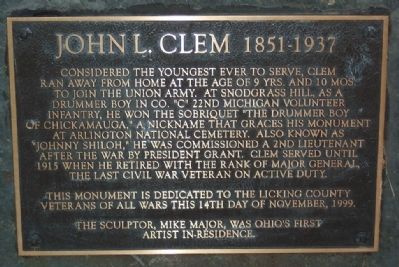
Also: Chickamauga Blog
On this date, 1863...
..Snodgrass Hill:
Three regiments that had been attached from other units—the 22nd Michigan, the 89th Ohio, and the 21st Ohio—were left behind without sufficient ammunition, and ordered to use their bayonets. They held their position until surrounded by Preston's division, when they were forced to surrender.
Tuesday, June 14, 2011
Guarenteed to alienate roughly half the popluation...
Thoughts on the American Civil War | OP FOR
Predictably, a second Civil War breaks out in comments...
(Or, the original continues. Whatever.)
Predictably, a second Civil War breaks out in comments...
(Or, the original continues. Whatever.)
Tuesday, April 12, 2011
On this day in history...
...in 1861 the Confederacy opened fire on Fort Sumter.
The blood would flow for four more years.
The blood would flow for four more years.
Subscribe to:
Posts (Atom)